Wisdom Forests

Background & Context
Transformations toward sustainability are increasingly recognised as involving not only changes in behaviour, institutions, and social systems, but also changes in how people experience themselves, others, and the world. Alongside this development, growing attention has been given to lived experience and first-person perspectives, including in contemplative science (Dahl et al. 2015; Dorjee 2016; Frank et al. 2024).
Our work builds on these developments and explores a simple but largely overlooked question: How do the phenomena that make up our lived worlds come to feel real, meaningful, and worth acting upon? Understanding these processes may help explain not only how people make sense of the world, but also how they engage with sustainability. A formal account of this framework is currently under development (Stark et al., in preparation).
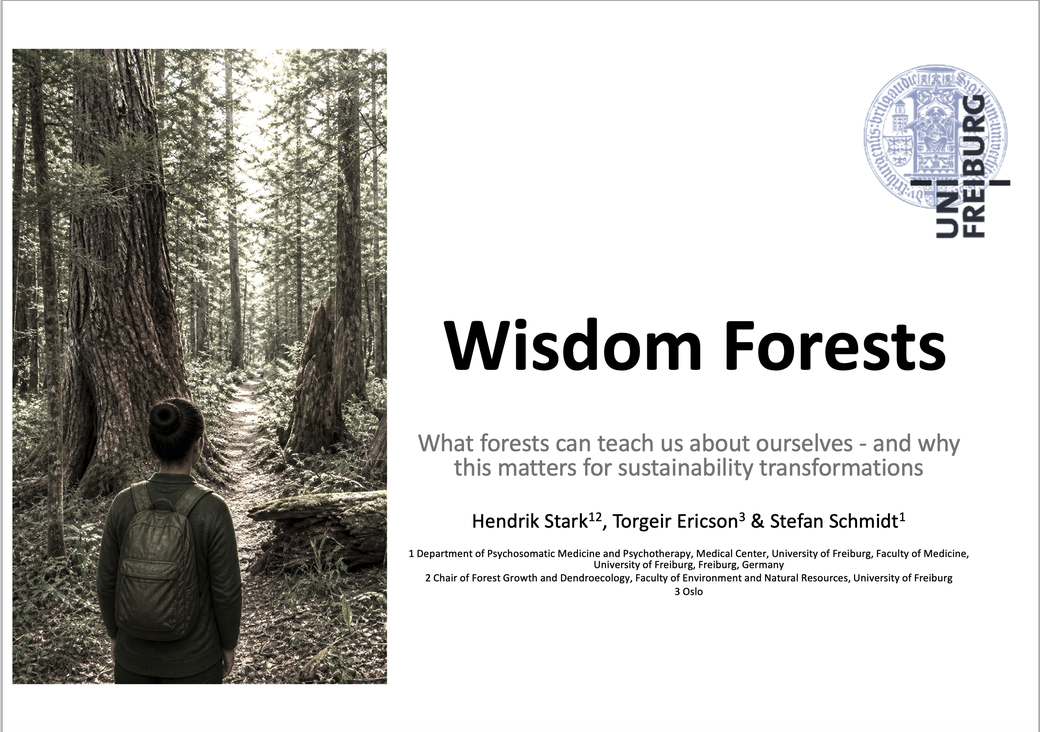
What forests can teach us about ourselves - and why this matters for sustainability.
Most of us have experienced that spending time in a forest can be calming, restorative, or simply help us see things differently. Research increasingly supports these experiences. Forests have been associated with improved wellbeing, reduced stress, and a stronger sense of connection with nature (Pritchard et al. 2020). At the same time, they play a vital role in addressing climate change and biodiversity loss while providing countless benefits to people and societies (IPCC 2023; IPBES 2019; FAO & UNEP 2020).
Wisdom Forests begins with a simple observation. Forests are living systems in which growth, decay, change, and interdependence continuously unfold before our eyes. These are not only characteristics of forests—they are also processes that shape our own lives. Yet in everyday life they often remain unnoticed or are understood only as abstract ideas.
Building on recent developments in contemplative science, we explore whether carefully observing these living processes can gradually transform how we experience ourselves, others, and the world (Dahl et al. 2015; Dorjee 2016; Dorjee et al. 2025). Rather than simply learning about forests, participants are invited to recognise in the forest patterns that also shape their own experience. Such shifts have been associated with greater openness, perspective-taking, compassion, self-transcendence, and more relational ways of engaging with the world (Dorjee et al. 2025; Vago & Silbersweig 2012; Trautwein et al. 2016).
A first qualitative pilot study in Norway combines guided observation in forests with reflective inquiry. Initial findings suggest that participants begin to notice patterns of change and interdependence not only in the forest, but also in themselves and their own lives, often accompanied by shifts in perspective.
Beyond individual experience, Wisdom Forests also explores how forests are understood culturally. Alongside their roles as providers of resources and ecosystem services, forests have long been places of identity, learning, inspiration, and cultural meaning (IPBES 2019; IPBES 2022). We ask whether forests might also be recognised as environments that help people reflect on fundamental aspects of life and their relationship with the living world. In this sense, Wisdom Forests is less about teaching people about forests than about creating conditions in which forests help us see ourselves, our relationships, and the world in new ways.
Outlook
Wisdom Forests is an emerging line of interdisciplinary research exploring how forests may help us better understand ourselves, our relationship with the living world, and their relevance for sustainability transformations. We are currently developing its conceptual foundations alongside empirical studies and practical applications.
We welcome collaborations with researchers, educators, forest practitioners, conservation organisations, and funding partners who are interested in exploring these questions together.
Here you can find our short talk on Wisdom Forests, delivered at the Wisdom Days Conference 2026 in Jyväskylä, Finland.
References
- Brück M, Abson DJ, Fischer J, Schultner J (2022) Broadening the scope of ecosystem services research: Disaggregation as a powerful concept for sustainable natural resource management. Ecosystem Services 53:101399. https://doi.org/10.1016/j.ecoser.2021.101399
- Dahl CJ, Lutz A, Davidson RJ (2015) Reconstructing and deconstructing the self: cognitive mechanisms in meditation practice. Trends in Cognitive Sciences 19:515–523. https://doi.org/10.1016/j.tics.2015.07.001
- Dorjee D (2016) Defining Contemplative Science: The Metacognitive Self-Regulatory Capacity of the Mind, Context of Meditation Practice and Modes of Existential Awareness. Front Psychol 7:. https://doi.org/10.3389/fpsyg.2016.01788
- Frank P, Wagemann J, Grund J, Parodi O (2024) Directing personal sustainability science toward subjective experience: conceptual, methodological, and normative cornerstones for a first-person inquiry into inner worlds. Sustainability Science 19:. https://doi.org/10.1007/s11625-023-01442-w
- IPCC Core Writing Team (2023) IPCC, 2023: Summary for Policymakers. In: Lee H, Romero J (eds) Climate Change 2023: Synthesis Report. Contribution of Working Groups I, II and III to the Sixth Assessment Report of the Intergovernmental Panel on Climate Change. Intergovernmental Panel on Climate Change (IPCC), Geneva, Switzerland, pp 1–34
- Klöckner CA (2013) A comprehensive model of the psychology of environmental behaviour—A meta-analysis. Global Environmental Change 23:1028–1038. https://doi.org/10.1016/j.gloenvcha.2013.05.014
- Lusthaus D (2002) Buddhist Phenomenology: A Philosophical Investigation of Yogacara Buddhism and the Ch’eng Wei-shih Lun. Routledge
- Stark H, Dorjee D, Trautwein F-M, et al (2025) Is the self a blind spot in our approaches to achieving sustainability? OSF preprint. https://doi.org/10.31219/osf.io/hs23f_v1
- Unai P, Balvanera P, Christie M, others (2022) Summary for policymakers of the methodological assessment of the diverse values and valuation of nature of the Intergovernmental Science-Policy Platform on Biodiversity and Ecosystem Services (IPBES). Zenodo, Bonn